While open floor plans have become must-haves for most, a subset of Hamptons homeowners choose to retain the nostalgia and charm of their smaller, separate cooking spaces.
“After years of open-concept living, there has been a noticeable return to defined spaces,” says Lana Wear, president and chief executive officer of HomeWear Designs. Wear encountered this decision in a reno project at a Westhampton residence that held personal sentiment.
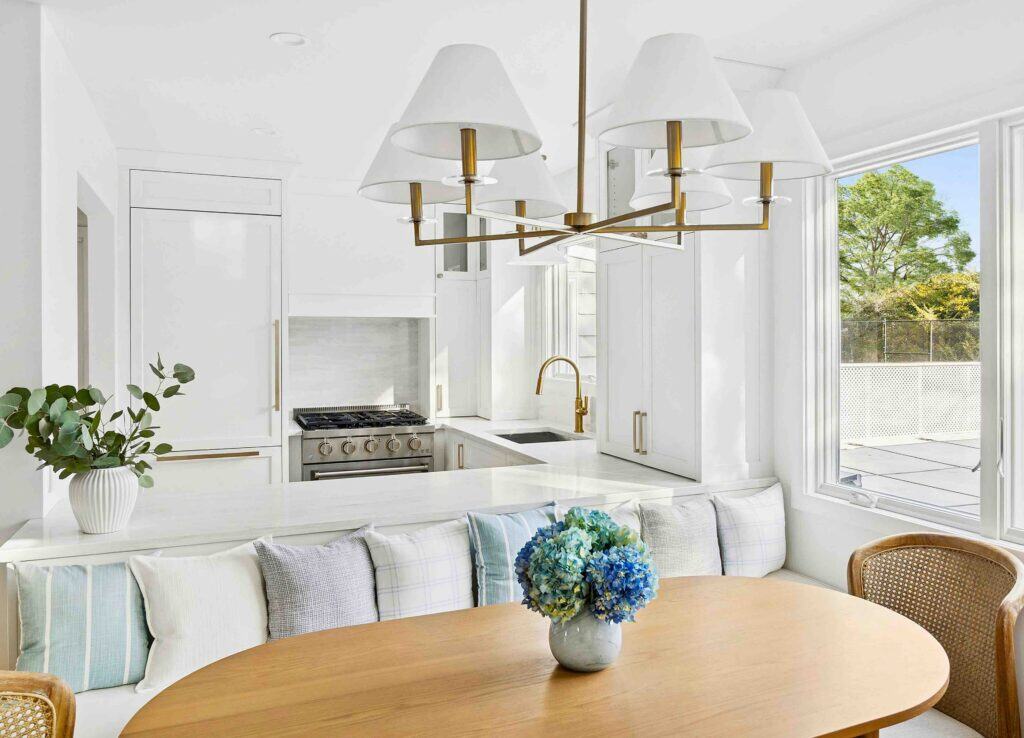
“The home had been in my husband’s family for 40 years, and the dining space held decades of family dinners and celebrations,” Wear says. “Rather than expanding into a combined living area, we chose to honor the original footprint and make it work harder.”
That shift extends to buyer psychology, adds Adam Hofer of Douglas Elliman, who often advises his clients on interior design and staging. “Not everyone wants a fully exposed kitchen,” he explains. “Some clients appreciate the separation.”
A defined layout “preserves the cozy integrity of the cottage,” Hofer adds. “There’s a romance to keeping the scale intact rather than turning every home into the same open-plan layout.”
Larger Than Life
A compact kitchen doesn’t need to feel cramped, Wear notes. When it comes to making a space feel larger, lighting and continuity are key.
“Natural light should be maximized wherever possible, and layered lighting — recessed, pendant and under-cabinet lights in a warm white — eliminates shadows that shrink a space,” she says. “Built-in dining nooks, continuous flooring between rooms and larger-format floor tiles can all create a seamless flow that makes the kitchen feel connected rather than confined.”
By eliminating an unusable counter overhang at her family’s Westhampton house, Wear added more than a foot of functional depth to the kitchen. She installed a custom full-length banquette with drawer storage, moved the microwave into a drawer and doubled the size of the kitchen window, centering the sink to frame the view.
A cohesive, light-toned palette creates visual expansiveness, Wear explains, while running countertops up the backsplash and integrating appliances reduces visual interruption. “Ceiling height also matters,” Hofer adds. “Even subtle changes like raising upper cabinets to the ceiling or incorporating vertical shiplap can draw the eye upward and create a sense of volume.”
The Art of Concealment
In a Hamptons cottage, storage must be as refined as it is resourceful. The kitchen in the North Fork home of Dan Mazzarini, founder and creative director at Mazzarini & Co., is “quite small,” he says, so he sourced a pine wardrobe from White Flower Farmhouse in Southold that now serves as a “makeshift pantry” for glasses, plates and platters. “Storage in a compact kitchen should be deliberate and architectural,” Wear agrees.
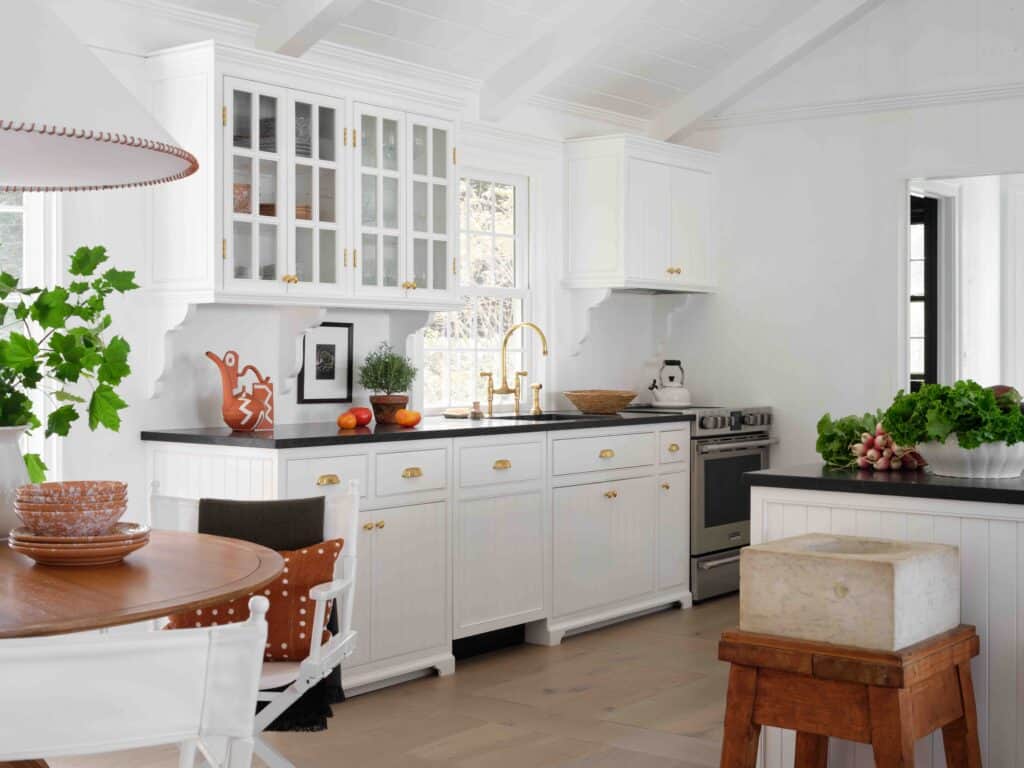
Photo: Reid Rolls
In her own redesign, custom upper cabinets run ceiling to counter, fully utilizing vertical space and corners, while integrated outlets allow small appliances to live out of sight. Details such as slim pull-outs for baking sheets and spices, vertical dividers and taller refrigeration profiles use every inch wisely. “In smaller kitchens, storage is not an afterthought,” Wear says. “It is a design driver.”
Entertaining With Ease
On the East end, where summer weekends frequently involve impromptu cocktails blending into lingering dinners, a smaller kitchen must rise to the occasion. “A separate beverage station is key,” Mazzarini says. In tight quarters, creativity counts: try “an undercounter fridge, floating shelves, a converted closet bar, or a stylish outdoor drink station during the warmer months to embrace indoor-outdoor entertaining.”
French doors, pass-through windows and easy access to terraces “can make even a compact kitchen feel like it supports a much larger gathering,” Hofer adds.
For Wear, entertaining success “comes down to strategic planning.” In Westhampton, expandable tables and narrow pull-outs add flexibility without clutter, while the full-length banquette added generous seating. “A smaller kitchen can absolutely function like a much larger one,” Wear says. “It simply requires understanding how a family uses the space and designing accordingly.”











![🎨 Through vibrant fabrics, layered textures, and intricate stitching, artist Nicole A. Vanasse transforms everyday moments into richly detailed works of art. Drawing inspiration from real life while inviting viewers to find their own meaning, her textile compositions celebrate memory, storytelling, and the beauty found in life's smallest details. Each piece is a reminder that art can be as much about the journey of creation as the finished work itself. [link in bio]](https://hamptonsrealestateshowcase.com/wp-content/uploads/sb-instagram-feed-images/763433386_18619953184030135_3337811349419388933_nfull.webp)