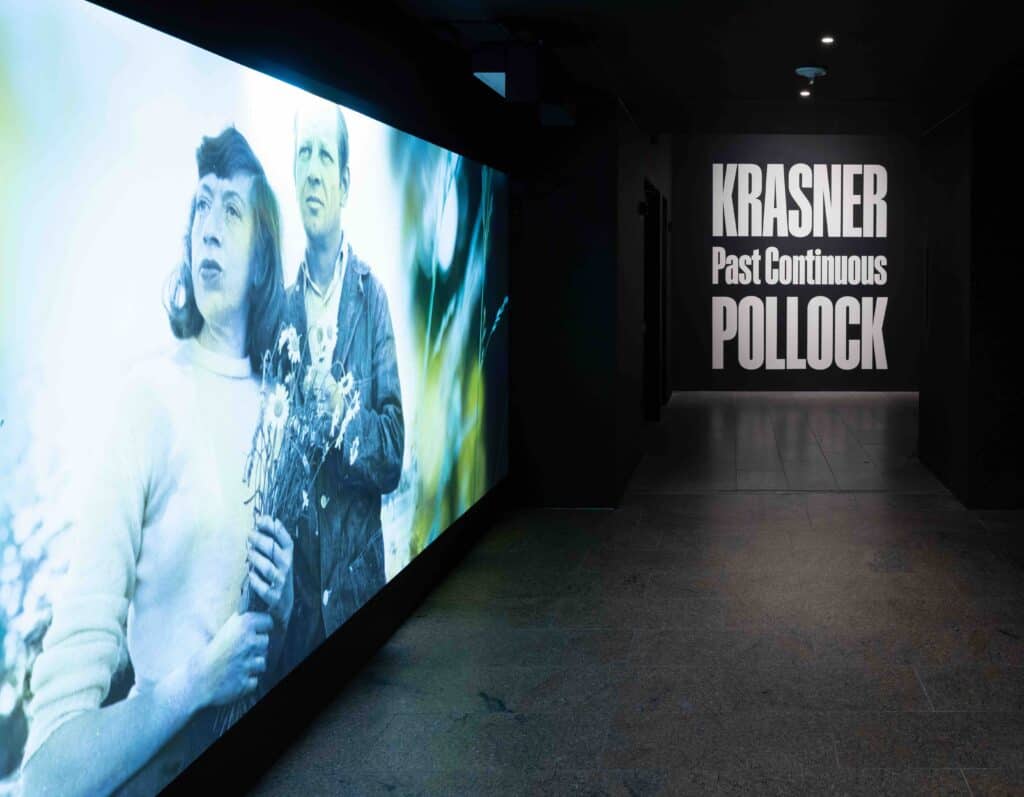
At the entrance to the exhibit, a video superimposes vintage photos of the seemingly happy couple enjoying the bucolic Accabonac landscape and their home and studios in Springs, now the Pollock-Krasner House and Study Center on Springs Fireplace Road in East Hampton. Many Hamptonites have visited this little house museum and are likely aware that Jackson Pollock, who suffered from mental health issues and alcoholism, died an untimely death in 1956 crashing his car while driving under the influence. It’s also likely that many are more aware of Pollock’s famous drip paintings than of Lee Krasner’s art. She was a devoted wife who tirelessly, and quite successfully, promoted his work including introducing him to the wealthy art patron Peggy Guggenheim. She was also subject to the unfortunate and now dated misconception that women painters were inferior. Krasner survived Pollock by 28 years, and her art flourished during that time.
The new exhibit aims to set the record straight. Krasner and Pollock are presented as equals with parallel careers which were significant in defining abstract expressionism. “Krasner and Pollock: Past Continuous begins with the fundamental premise that these artists are equals, partners in life, giants in the history of art and revolutionaries who defined what abstraction could be,” explains David Breslin, Curator in Charge of Modern and Contemporary Art.
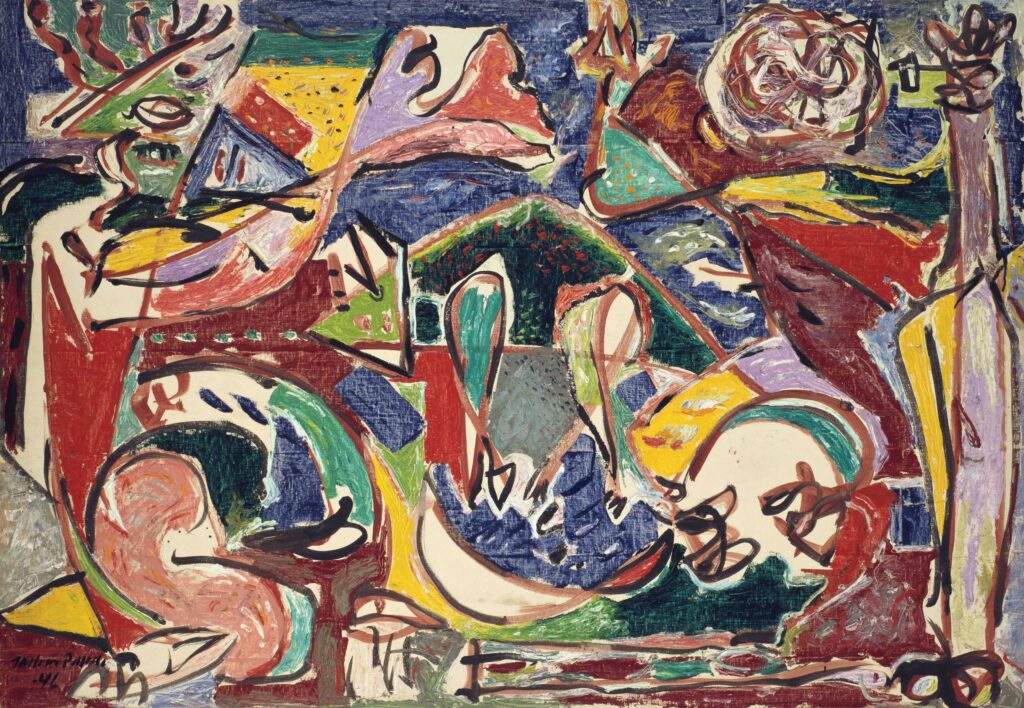
The exhibit “approaches these artists not as a single story, but as two practices unfolding in proximity over time,” says co-curator Brinda Kumar.
Over 120 works from more than 80 U.S. and international lenders comprise the show. It’s the first major presentation of either artists’ work in more than two decades. The scale is staggering with many of the paintings measuring close to 20 feet in width.
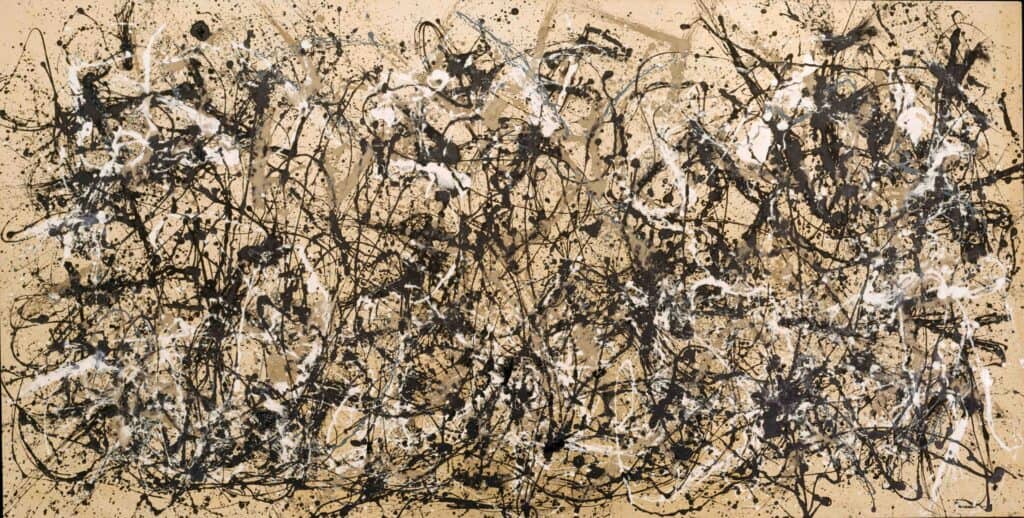
The exhibit is mounted in a cavernous, high ceilinged space on a number of free standing ‘walls’. It serves as a visual biography of the lives and careers of the two artists.
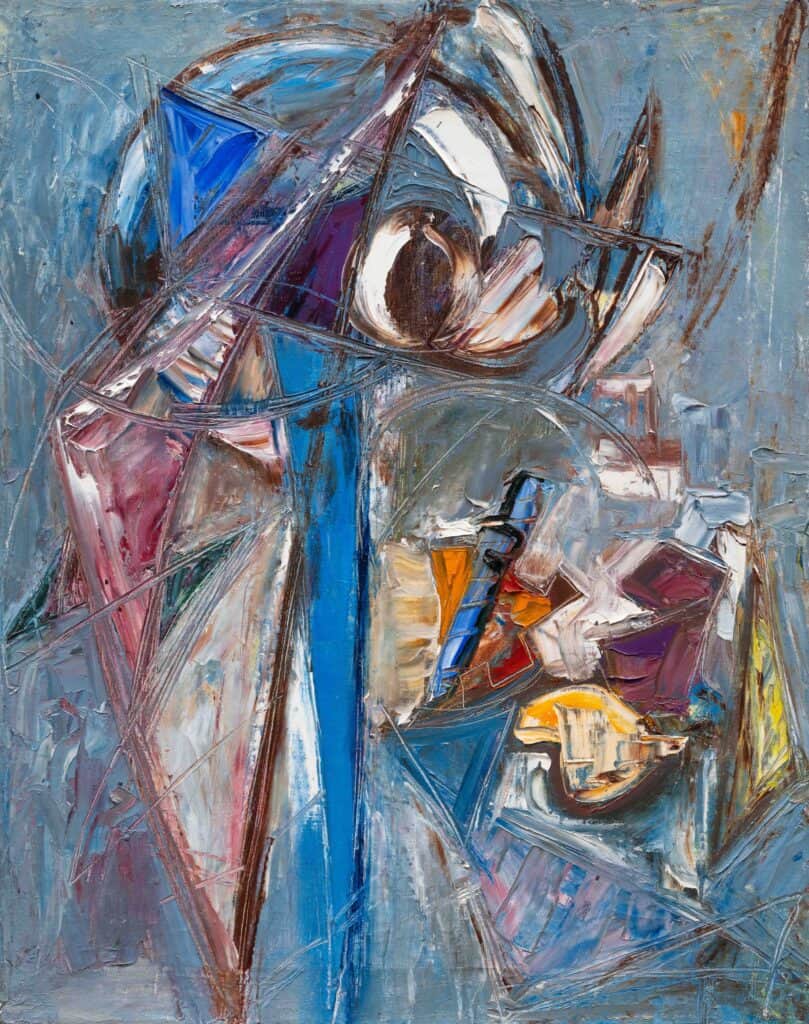
Krasner was born in Brooklyn to parents who were refugees from what is now Ukraine and grew up in an Orthodox Jewish household. She had a traditional education, was heavily influenced by the styles of Matisse, Picasso, and Mondrian which she encountered at the Museum of Modern Art and trained under Hans Hoffman and immersed herself in Cubist theory. Pollock was a son of the American West. He was born in Cody, Wyoming but his family moved around between Arizona and California. He was influenced by early exposure to Navajo sand painting and other indigenous art and later trained with Thomas Hart Benton. Both set out to establish careers as artists in New York City. They met when they were included in an exhibit organized by the artist John Graham in 1942. One thing led to another and they married in 1945. They soon moved to Springs, partly to distance Pollock from the city’s bars. They lived and worked there until Pollock’s tragic death. The exhibit is organized in 12 chapters that span each artist’s career including Krasner’s Little Images series to Pollock’s drip paintings and monumental canvases and Krasner’s large-scale Umber and Earth Green series.
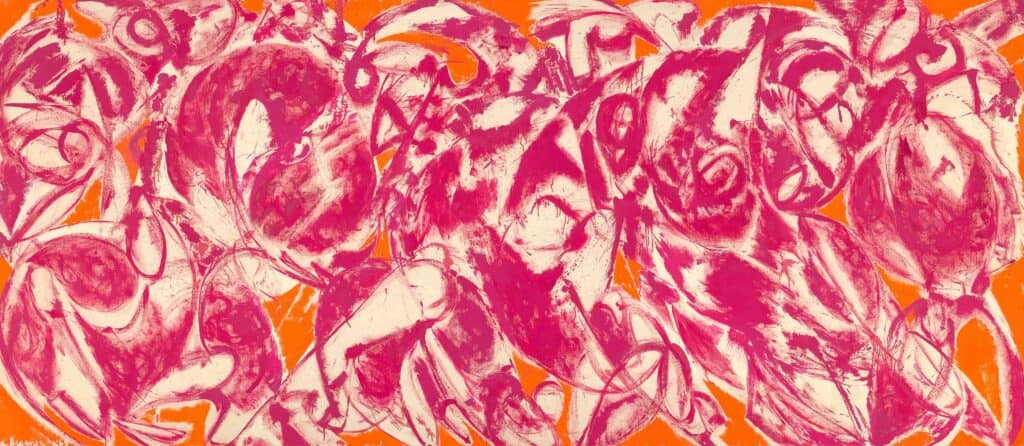
It’s definitely worth a visit to the Met to see this spectacular exhibit featuring the landmark works of these two remarkable East End artists.