While many artists are looking to the future with technological advances, renowned artist and curator Bonnie Rychlak reaches back in time to the rich history of encaustic art. Using hot wax techniques dating back to when the Greeks utilized them to both seal and decorate their boats, Rychlak perfects this labor-intensive method to create depth and resonance in her works. “It was abandoned for centuries until electricity was discovered and created another way to heat and paint with the wax. It also has to be applied horizontally because it drips. It’s such sensuous material, very fleshy and beautiful. There may be drawbacks but it’s worth it.”
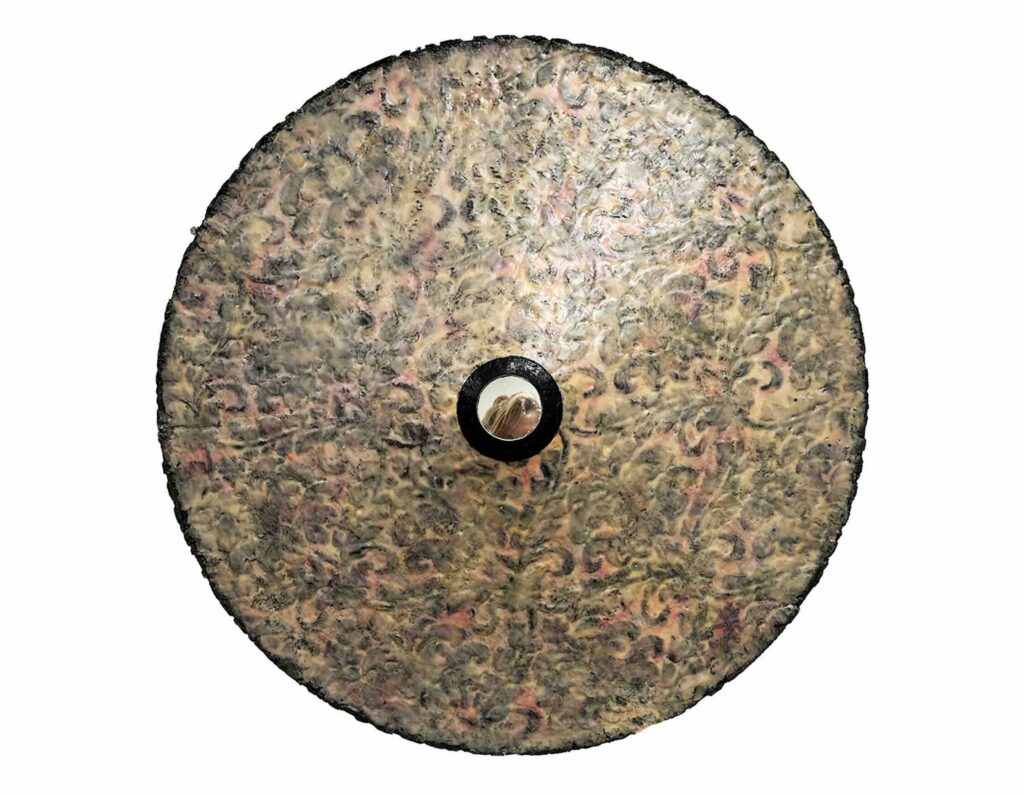
Encaustic over fabric and concave mirror 36 x 6 inches
Rychlak earned a Master of Fine Arts at the University of Massachusetts, Amherst and a Bachelor of Arts at the University of California at Los Angeles. She has been awarded many prestigious honors including a Fellowship from The American Academy in Rome, a 1985 Rockefeller Foundation, Bellagio Residency and 1976 National Endowment for the Arts, Sculpture. While she has traveled the world, she finds solace returning to her beloved home and studio in the Springs in East Hampton.
Rychlak will be teaching the encaustic artistic method to the public at a special series at the Bridgehampton Museum, another place honoring history in its renovated Nathanial Rogers House, at the end of September. She will work with students with wooden substrates covered with gesso then melting the wax and adding pigment to it. “It’s all about how you apply it,” she explains, “The most important thing about using encaustics is it’s like watercolors. It’s about understanding layers and transparency. You can really dive into the surface if you know how to use it properly. After it’s applied you can leave the brush marks or you can use a heat gun for smooth surfaces.”
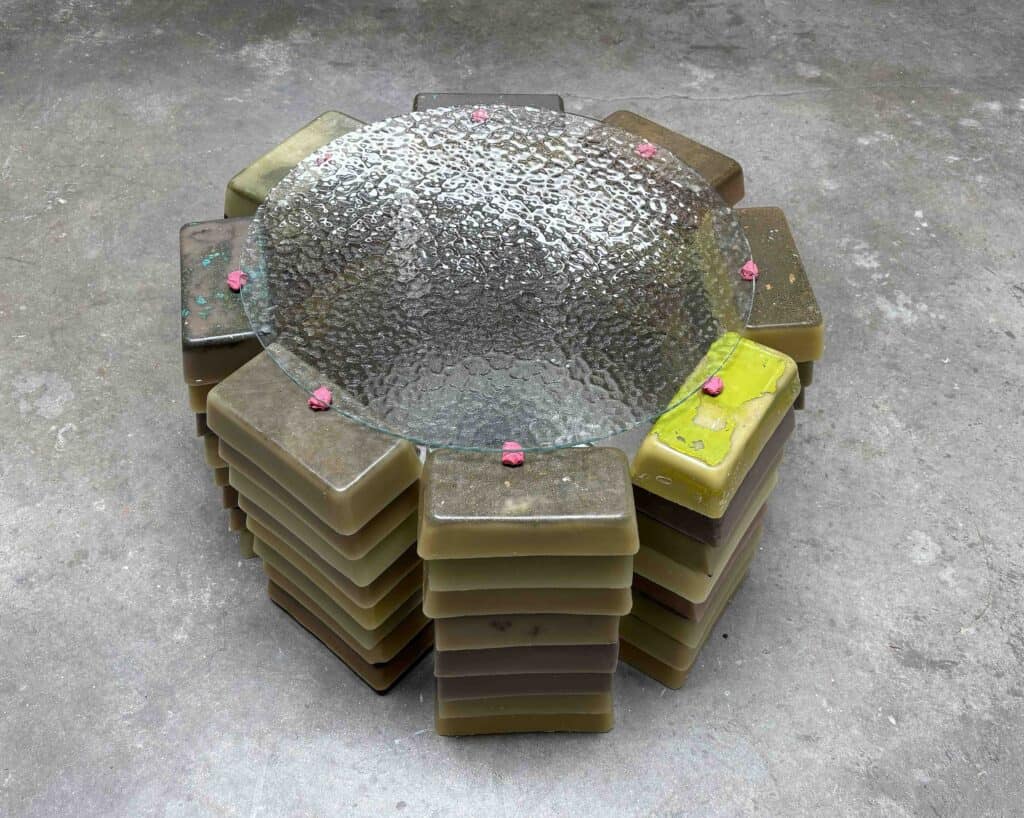
Cast wax, glass, mirror, metal drain, and Sculpey 24×24 inches
At a recent solo exhibition at the renovated tractor barn at the William A. Corwith Homestead, Rychlak took advantage of the space to present her work in non-traditional ways to allow the viewer to have a more visceral experience. Her method is taking upholstery fabric and stretching it, making protrusions from behind the canvas then layering on colored hot wax. Her use of materials of strong, thick fabrics can absorb the wax, creating a unique visual and tactile surface, combining the domestic textile with the ancient, enduring wax. “Conceptually it’s about what you see and what’s underneath,” she explains. Her iconic circular forms are often associated with a drain motif, even placed directly on the floor. They even inspire symbols of Jungian psychology and the subconscious. “Drains can be very scary when you look down them, a fear or being sucked into it. What are the blockages or hidden detritus?”
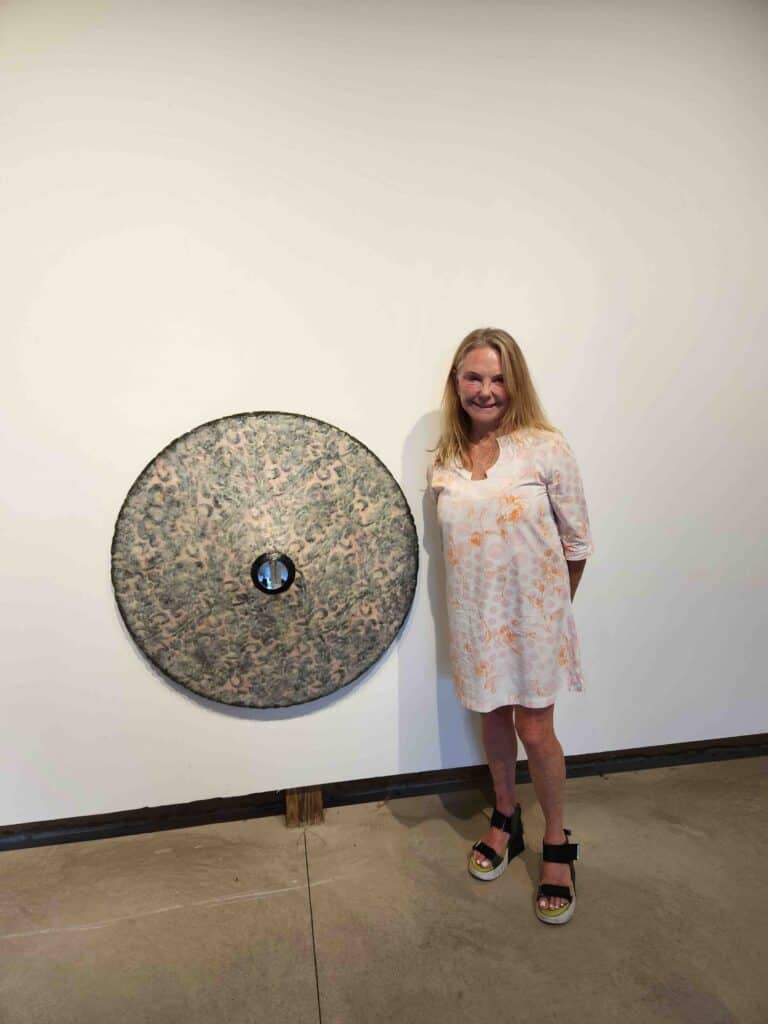
Rychlak also purposely hangs her circular wall pieces at belly, not eye level. “I want the pieces to be more sculptural and object-like than paintings,” she comments, “It gives one an opportunity to see the protrusions more strongly. The mirrors are also concave on the pieces, so you get turned upside down. And in all of these pieces, the center is not centered. Each is slightly off center. I am trying to play with the optical relation to bring you in and push you away.” Her work invokes both a modern sensibility and a nod to antiquity.
Through the layers of wax and the layers of time and the layers of the human psyche, Rychlak invites us to see what layers of truth are revealed.








![🎨 Through vibrant fabrics, layered textures, and intricate stitching, artist Nicole A. Vanasse transforms everyday moments into richly detailed works of art. Drawing inspiration from real life while inviting viewers to find their own meaning, her textile compositions celebrate memory, storytelling, and the beauty found in life's smallest details. Each piece is a reminder that art can be as much about the journey of creation as the finished work itself. [link in bio]](https://hamptonsrealestateshowcase.com/wp-content/uploads/sb-instagram-feed-images/763433386_18619953184030135_3337811349419388933_nfull.webp)