You know the kitchen the moment you walk into it. Not because it overwhelms you, though it might, but because it feels genuinely lived in. There is a dusting of flour left from the morning. A jar of garden roses that no one labored over. The pleasant disorder of a dinner that ran late and that nobody wanted to end. This is the English country kitchen, and it has arrived in the Hamptons with a kind of quiet inevitability.
The connection runs deeper than style. Both worlds treat the country house as something close to sacred. Both believe the best rooms prove themselves through use rather than careful staging, and both hold to the old conviction that the kitchen should remain the warmest room in the house regardless of the season. What the English spent centuries refining, the deep apron sink, the scrubbed oak table, cabinetry painted in colors drawn from the garden wall, settles with surprising ease into the shingled cottages and converted barns of Southampton, Bridgehampton, and the North Fork. It never feels borrowed. It feels like it belonged here all along.
Bunny Williams, whose work has moved between London and the East End for decades, has put it plainly. “The English country kitchen is not about decoration,” she has said. “It is about a way of living that values comfort, generosity, and the beauty of everyday objects used well.” It is a language the Hamptons already speaks fluently.
At the heart of the room is the Aga, or whatever range carries its warmth and spirit. It radiates whether or not anything is cooking. People drift toward it on cold mornings and find themselves still there through long evenings. In the Hamptons, where September turns cool without warning and the house grows a little quieter once the summer guests have gone, that steady warmth carries real meaning. Designers out here have noticed a renewed appetite for ranges with an old-world soul. La Cornue. Lacanche. The occasional Aga, carefully restored and treated less like an appliance than an heirloom.
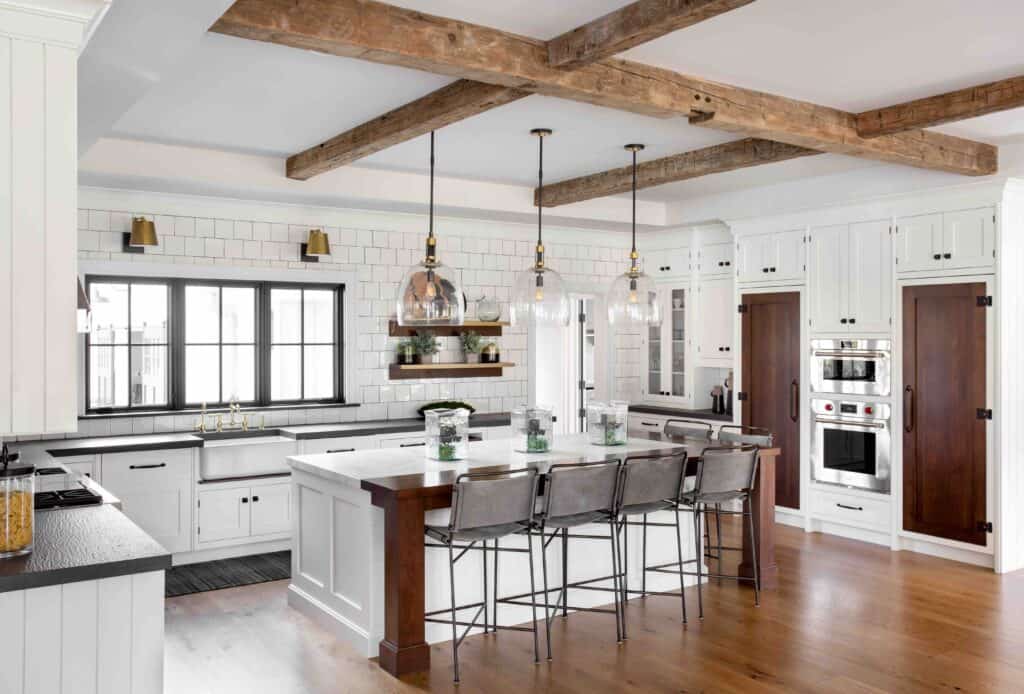
The cabinetry refuses to match, and that is precisely the charm of it. Open shelves hold the everyday mugs beside the good china without a second thought. A plate rack rests above the sink. Glass-fronted doors reveal what deserves to be seen. The colors come from the landscape rather than a trend report: sage, slate, mineral green, a register of cream that reads one way in the afternoon and another entirely after dark. In the Hamptons, where summer light runs sharp and white and autumn turns everything to amber, those choices reward the attention paid to them.
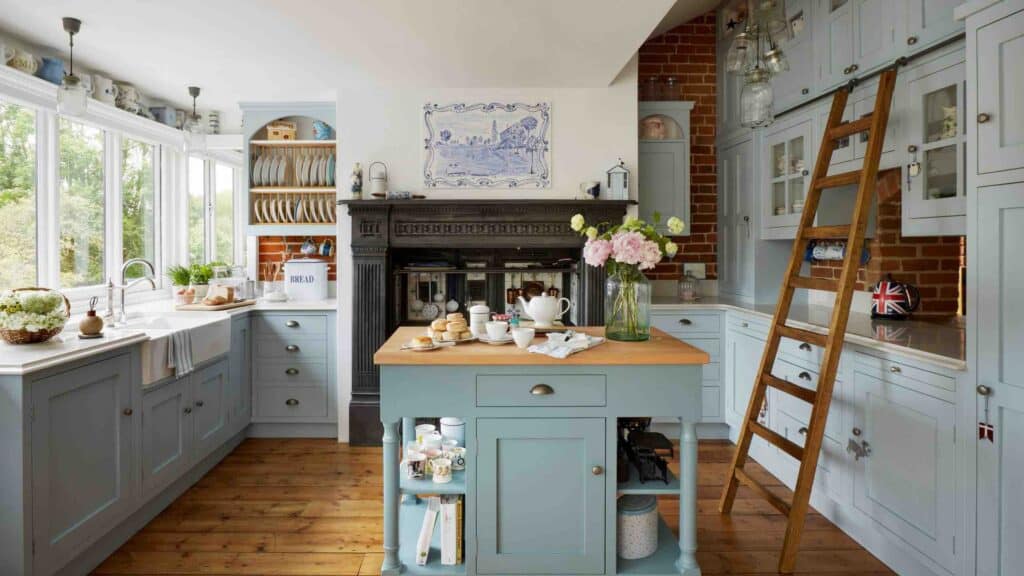
The island, where there is one, leans toward butcher block or marble that has earned every mark. The stools do not match, by design. The light hangs rather than hides, a lantern or a loose cluster that throws warmth across the room. Herbs crowd the windowsill. The dog has claimed the spot by the door and has no intention of giving it up.
What the most perceptive Hamptons designers have understood is that an English country kitchen cannot be copied. It has to be felt. It rewards the slow gathering of things chosen for their usefulness, the preference for what works over what dazzles, and the quiet belief that a kitchen should make people feel welcome rather than careful.
At a moment when so much design drifts toward the clean and the spare, there is something wonderfully stubborn about a room that simply wants you to pull up a chair and stay. The English have known this for a very long time. The Hamptons, it turns out, was always ready to listen.