The interior designer James Michael Howard lists his own East Hampton compound
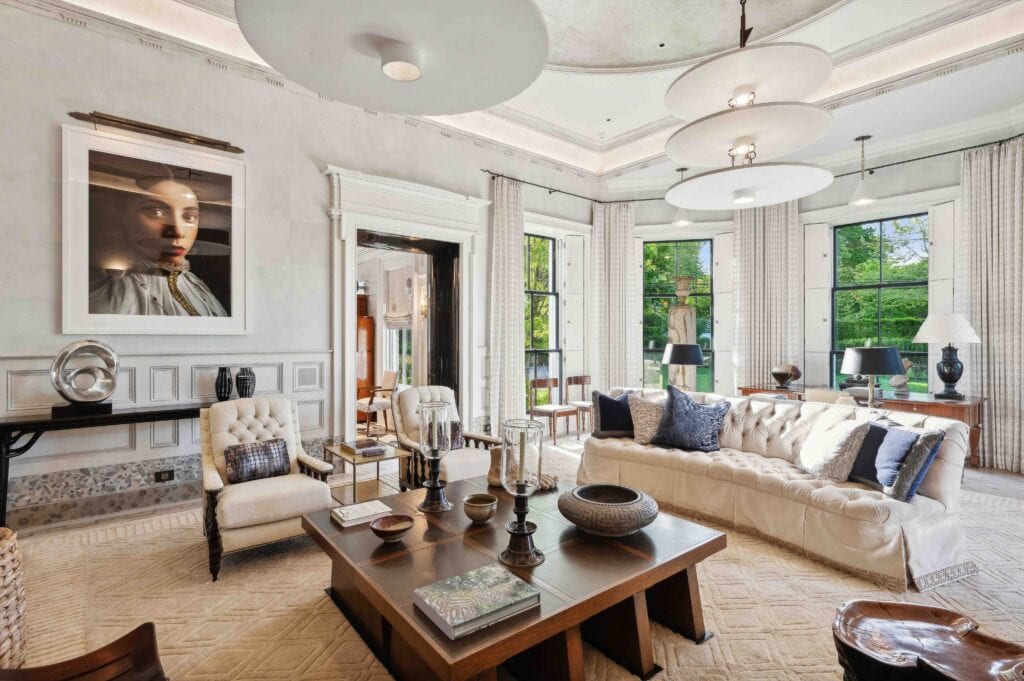
When a serious piece of real estate changes hands in the Hamptons, it’s practically a given that a redesign is in order. Bring on the decorator! Yet no outside help was necessary when James Michael Howard and his wife Phoebe bought a property in East Hampton’s mansion district, given that Howard is an interior architect and a designer. Now they are selling it, furniture and all. Located just a mile from the beach, the 11,644-square-foot, eight bedroom, eight bathroom estate on Hither Lane is listed at $24,950,000 with Gary DePersia of The Corcoran Group and Martha Gundersen and Paul Brennan of Douglas Elliman Real Estate. And it’s a relative bargain, considering that whoever buys the property will be spared the ordeal of having to deck out all those rooms, much less knock down a wall or change the floor plan. (Though all the furniture is for sale, not every piece is included in the purchase price.)

“I’m an old guy,” says Howard, “and over the years I’ve learned a lot of things about how to design a fabulous house. We’d planned to keep this one and so I designed it for the two of us.” That’s an understated way of saying that he spared no expense.
On discovering he couldn’t enlarge the footprint of the contemporary-style house, he said to himself, “I can fix this.” The fix entailed one hundred and thirty-five pages of plans. He moved the house thirty-five feet forward, which allowed him to create a spacious yard, a pool, and a pool house. He added a screening room, a billiard room, additional guest suites, and a detached two-car garage with a white oak loft. He replaced existing windows with oversized ones to bring in tons of light. Naturally, he also redesigned the floor plan. For privacy, he relocated the bedroom suites away from the living spaces. “I try not to ‘stack’ bedrooms on the upper and lower floors,” he says. That way you don’t hear the people below you or vice versa.

“I like to think about how you can make everybody feel really good.” According to Howard, the answer is to pay attention to details large and small. “You do it by making sure that the bathroom vanities are big enough to hold all your guests’ things. You make sure the shower has good water pressure and the TV is accessible and the right size but at the same time it’s not the focal point of a room.” (In this respect he adheres to what he calls ‘the rule of advancing and receding.’ In short, the idea is to make certain objects more prominent and others less so and still others disappear.) “It’s more of a scientific process rather than an artistic one,” he says, “and the effects are subliminal.”
For Howard, such concerns are second nature while interior decoration constitutes “the hard part.” As he and his wife host a large circle of friends, he endeavors to please everybody in a style he calls “unified eclecticism.” The word ‘luxury’ is over-used these days, but it applies to Howard’s choice of finishes, from the quarter-sawn white oak cabinets in the kitchen to the rosewood banquette with a brass top rail in the same room, which overlooks the leafy backyard. Of the first, he says “I like cabinets that you don’t have to be afraid banging into or scuffing up and ours are made from a practical but beautiful species of wood. Of the second: “Who does a rosewood banquette? Not a developer, that’s for sure.”

Other eye-catching details include hand-stitched Roman shades with different kinds of trim in the dining room. Their design was inspired by a screen that Howard saw in France and which in its intricacy reminded him of a couture gown. Also French-inspired are the lacquered cabinets and doors in the oval dining room and the velvet-clad walls. Like much of the furniture in the house, the oval chandelier is vintage, a 1940s piece from Italy — and its shape moved Howard to design a ten-seat oval dining table to match. All around the circumference of the upper edges of the walls are two hundred and fifty-six tiny handmade antiqued mirrors, each one ever-so-slightly different. “Light bounces off them and they bring a dazzle to the room,” he says.


Other one-of-a-kind pieces which are either included in the sale of the house or available at extra cost are a leather André Arbus desk and an eighteenth-century bouillotte table from Italy. And then there’s the low cabinet in the dining room that’s clad in tobacco leaves and edged with ivory. “The hinges are the most extraordinary hinges you’ve ever seen in your life,” Howard says. How does he know? Because he designed them himself.





![Indoor/outdoor living has evolved far beyond the patio or poolside seating area 🌿 Today’s most thoughtful homes are designed to blur the boundaries between inside and out, creating spaces that support everything from entertaining and wellness to everyday relaxation. With flexible layouts, durable materials, and a stronger connection to the landscape, the next generation of East End living is focused on how a home feels and functions throughout the year. [link in bio]](https://hamptonsrealestateshowcase.com/wp-content/uploads/sb-instagram-feed-images/710830844_18598759708030135_2167851243877024321_nfull.webp)
![A home should tell the story of the people who live there ✨ Designer @samtannehill of @tannehillinteriors believes the most successful spaces are the ones that feel warm, layered, and deeply personal. Through thoughtful materials, natural color palettes, and an emphasis on how families actually live, her Southampton home reflects a design philosophy rooted in comfort, function, and connection. The result is a timeless interpretation of Hamptons living that feels collected, lived-in, and effortlessly welcoming. [link in bio]](https://hamptonsrealestateshowcase.com/wp-content/uploads/sb-instagram-feed-images/708953286_18598495174030135_5355474848495384064_nfull.webp)