The home theater was once the ultimate luxury-home status symbol: a darkened room tucked into the basement, complete with rows of leather recliners, a giant screen, and perhaps a popcorn machine for good measure. Then came open-plan living, increasingly sophisticated televisions and an explosion of streaming content. Why dedicate an entire room to movies when virtually anything worth watching could be streamed from the comfort of the sofa?
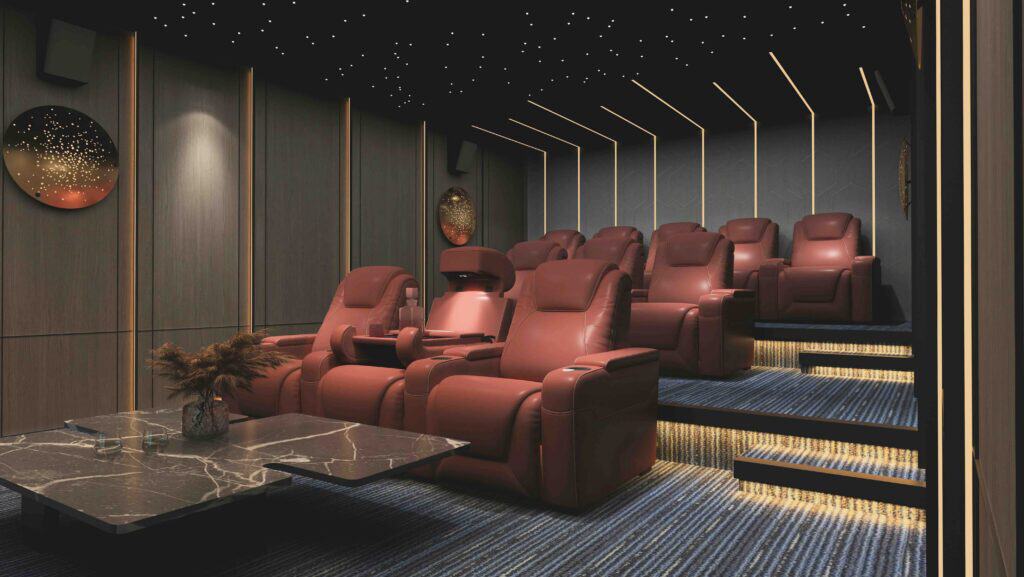
For today’s luxury homeowner, however, that question is starting to have a different answer. The quality of home viewing has caught up with or even surpassed the multiplex, while the cost and limitations of the traditional movie-going experience have made staying home more appealing.
At the same time, years of working and living at home have renewed an appreciation for rooms designed around specific experiences rather than spaces expected to do everything. Today’s private cinema is less about recreating a commercial theater and more about creating a highly personal retreat: a place where sophisticated sound, spectacular images, thoughtful lighting, and exceptional comfort come together—whether the feature is a new release, the Super Bowl, or a Saturday-night streaming binge.
The Sound
A great home theater starts with what you hear. Just as important, however, is what you don’t hear. “Good acoustic design starts with two questions: what sound do you want to keep in, and what noise do you want to keep out?” says Jeff Pelletier, Strategic Construction Advisor at Real EstateBees. Soft surfaces can reduce echoes and reverberation, while acoustic panels help control reflections and improve dialogue clarity.
That combination of hard and soft surfaces is key, says interior designer Irene Cara of Nova Wrap. Bare drywall, glass, and tile can make sound bounce around the room, muddying it to the point that it’s hard to understand speech sounds. Carpeting, textured rugs, heavy drapes, and strategically placed acoustic panels can all help create a more controlled listening environment. The goal isn’t a room that deadens sound, but a room that works to balance it for optimum comfort and comprehension.
Architect Robyn Thomas took a similar approach in a recent project, incorporating carpeting and bringing in a specialty theater-design company to determine where additional acoustic panels were needed for the room’s particular layout.
Keep that distinction Pelletier mentioned in mind, however: acoustic treatment isn’t the same as soundproofing. Panels and soft furnishings improve sound inside the theater, while true sound isolation keeps the movie (especially those low-frequency rumbles) from disturbing the rest of the house. That generally requires construction techniques such as additional mass, airtightness and decoupling in walls, ceilings, and floors.
The Sight
A spectacular picture is about more than choosing the biggest screen that will fit the room. Sightlines, screen placement, projection, and lighting all have to work together—ideally, long before the first piece of equipment is installed.
For dedicated cinemas, projectors remain the go-to for creating an immersive, truly large-scale image. Dolby notes that 100- to 150-inch images are common in advanced home theaters, while CEDIA, a global trade association for smart home technology professionals, recommends considering the room’s dimensions, ambient light, and desired screen size when choosing between a projector and television.
Placement matters, too. THX recommends designing the room so viewers have unobstructed sightlines, with a viewing angle of about 36 degrees from the farthest seat. Projector and screen positioning should be planned together to avoid image distortion.
Then comes the lighting. It’s not simply a matter of turning everything off when the movie starts. Instead, aim for the creation of layers that can be adjusted independently. “For lighting [in a recent project], we created multiple layers of lighting, each with dimming and on/off capabilities,” says architect and interior designer Robyn Thomas. That allowed her team to illuminate a rear refreshment station without flooding the entire theater.
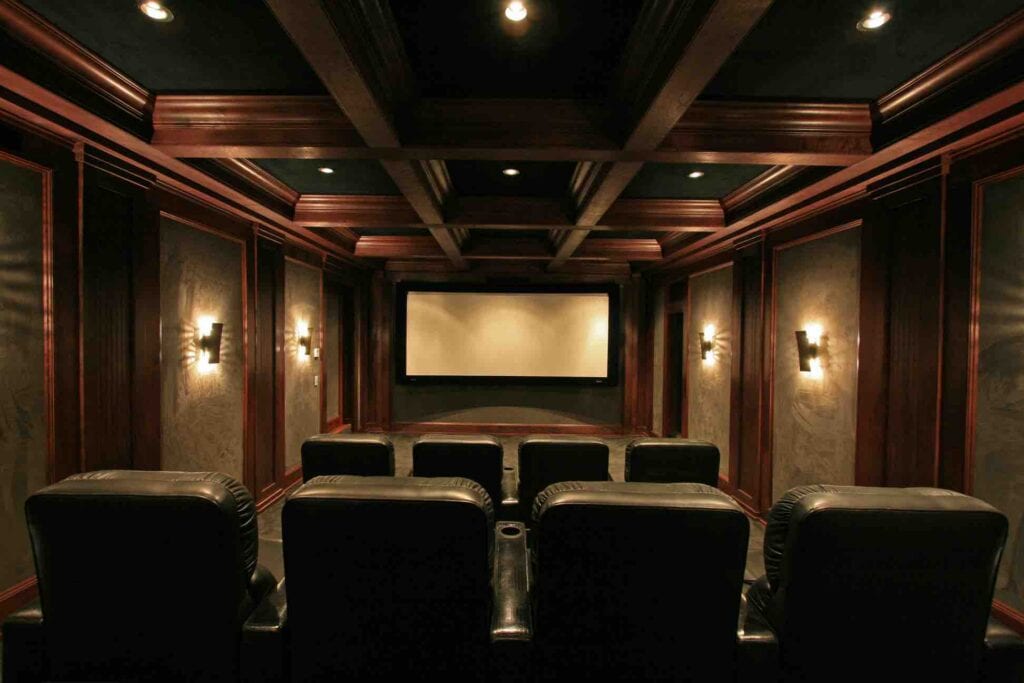
Interior designer Irene Cara recommends recessed fixtures, dimmers, and floor lighting for safety, while keeping light off the screen. Dark or low-sheen walls and ceilings can further reduce glare. Jeff Pelletier likewise favors dimmable ambient lighting over harsh recessed cans, along with soft flooring and carefully concealed fixtures.
Increasingly, the luxury of a home theater incorporates the ability to control several environmental elements. Integrated systems can coordinate lighting, motorized shades, and even climate control all at the touch of a button.
The goal is simple: once the lights fade, nothing should distract from the screen.
The Seat
Even the most spectacular screen and sound system can fall flat if the audience isn’t comfortable. But in a private cinema, seating has to do more than provide a place to sit. It also has to preserve sightlines.
“Every seat should have a clear, undistorted view of the screen,” says Pelletier. That often means tiered or staggered rows rather than seating everyone on the same level. As a designer, Cara also recommends recliners and raised seating platforms for rooms with multiple rows. However, she points out that too many rows can make the space feel cramped.
For one recent project, architect and interior designer Robyn Thomas selected theater-specific chairs with reclining seats, cup holders, and even integrated speakers. Today’s luxury options can go considerably further than earlier options, with custom configurations, premium upholstery and features ranging from power recline and adjustable headrests to concealed storage and USB charging.
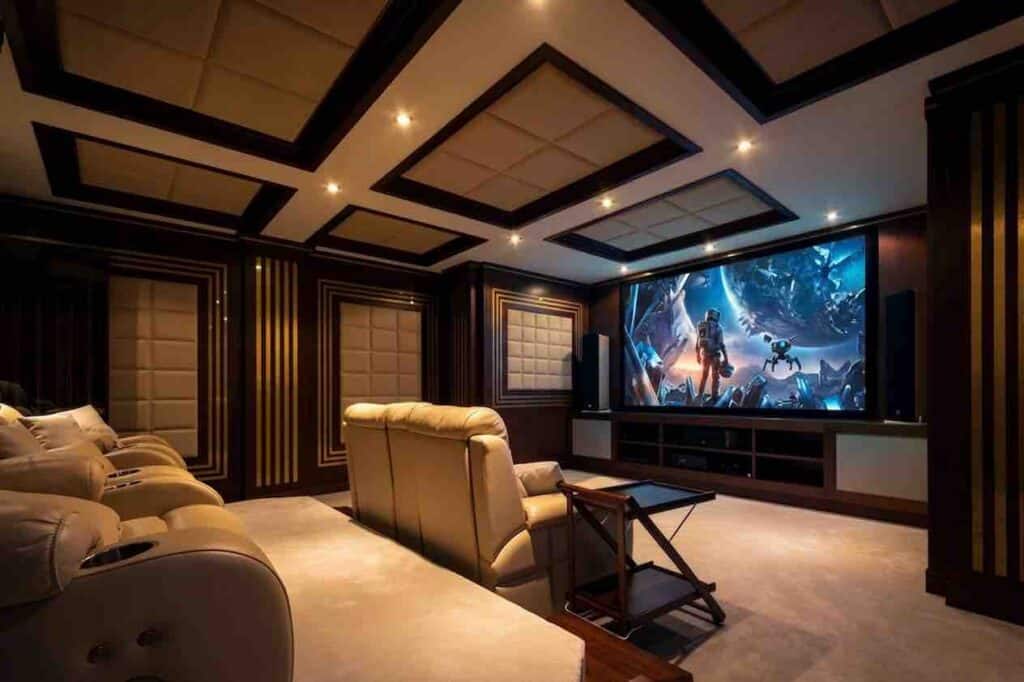
But the traditional row of identical recliners isn’t the only option. Designers increasingly favor a more residential approach, incorporating a mix of low-profile recliners, deep sofas, loveseats, modular seating and oversized ottomans into screening rooms. Pelletier takes a similarly flexible approach: “We always aim to design in a mix of seating with a big sofa for movie nights and a couple of individual chairs for the person who just wants to watch alone.”
The guiding principle is simple: luxurious seating should support both the view and the experience, while still making the room feel like a beautifully designed part of the home.
The Extras
A luxury screening room doesn’t have to be devoted exclusively to Hollywood’s latest and greatest. For one of Robyn Thomas’s clients, the theater was designed as much for watching sports as movies and television series. “The emergence of streaming has made this option a necessity for them,” she says.
That flexibility is increasingly part of the appeal. As streaming libraries have exploded and picture quality has improved, a dedicated theater can serve as a destination for everything from a championship game to a family movie night.
The technology can also disappear when it’s not in use: automated shades, lighting and climate controls can transform the room from an everyday living space into a fully immersive viewing environment at the touch of a button. CEDIA identifies integrated control of lighting, shades, and other home systems as an increasingly important part of the home-theater experience.
The architecture itself can accommodate some delightful surprises. In one project, Thomas took advantage of a bay-shaped section of the basement to create a concealed mudroom, giving guests a place to remove their shoes before entering the theater without passing through the rest of the house. Pelletier recalls another remodel in which the team actually lowered the basement floor to achieve the ceiling height necessary for the desired theater experience.
That kind of customization may be the ultimate luxury: Instead of squeezing a theater into whatever space remains, you can design the house around the immersive viewing experience you want.