If there’s one thing the Hamptons never fails to deliver — besides traffic, rosé, and existential panic over dinner reservations — it’s real estate news with enough zeros to make even seasoned hedge fund managers blink. This week’s dispatch comes courtesy of Water Mill, where two of the hamlet’s most recognizable retail properties just traded hands for a combined $39 million, reportedly marking the largest retail real estate transaction the South Fork has ever seen.
Retail Splendor
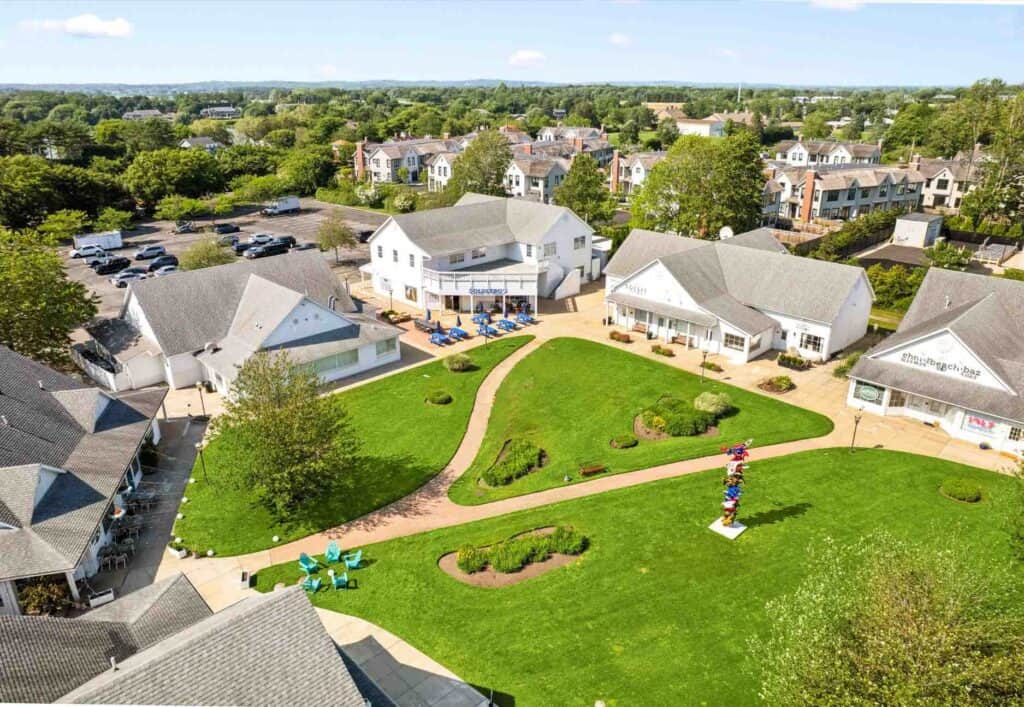
The properties in question are hardly obscure. Anyone who has crawled eastbound on Montauk Highway at 14 miles per hour on a summer Friday knows them well: Water Mill Square at 670 Montauk Highway and The Mill at 760 Montauk Highway. Together, they account for an astonishing 84 percent of Water Mill’s gross leasing area — which is both impressive and a reminder that “downtown Water Mill” remains more concept than metropolis.
of Compass
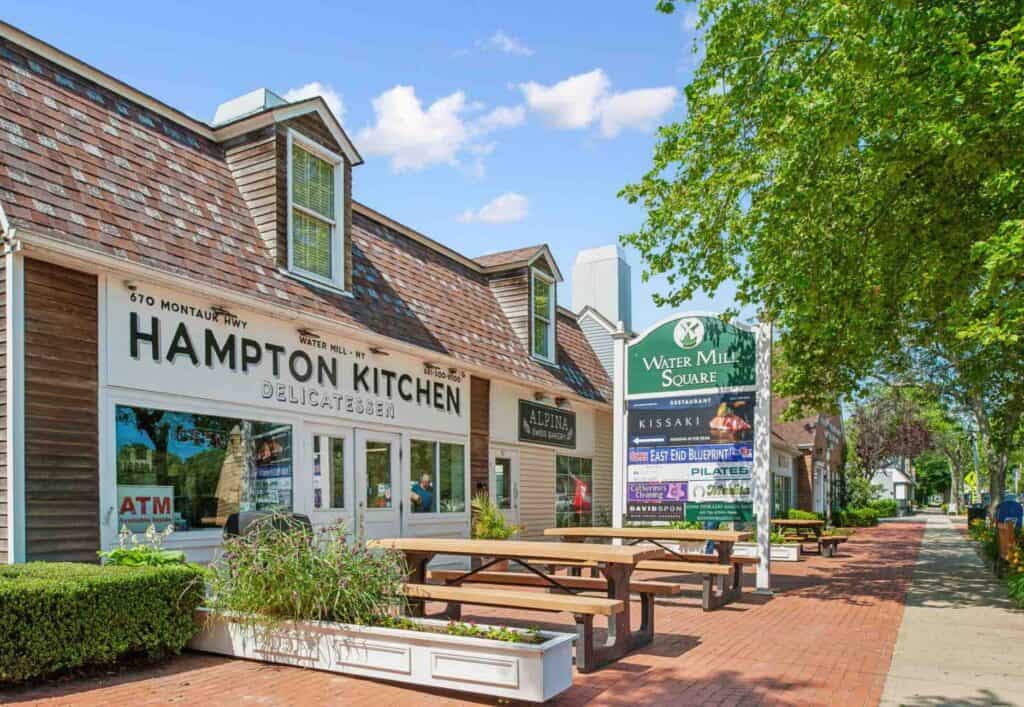
The sellers were Robert Zecher and Benjamin Rinzler of Vault Development Partners, while the buyers, naturally, remain unnamed because discretion is still the preferred Hamptons accessory. Compass brokers Hal Zwick and Jeffrey Sztorc of Hamptons Commercial Real Estate handled the transaction.
And honestly, if you wanted to build a near-monopoly on Water Mill commerce, this was the way to do it.
Water Mill Square spans 20,500 square feet across 2.26 acres, while The Mill stretches across 29,314 square feet on 3.66 acres. Between the two properties, you’ve got restaurants, lifestyle brands, boutique retail, office tenants, and enough upscale wellness adjacency to sustain at least three conversations about cold plunges before your appetizer arrives.
“This is one of the best assemblages I have ever seen created and sold,” Zwick said, which in commercial real estate language is roughly equivalent to a standing ovation.
He’s not wrong. Retail property in the Hamptons has quietly become one of the East End’s most competitive asset classes. Residential real estate tends to dominate headlines because beachfront mansions are easier to photograph than parking lots, but the real scarcity play may now be retail. There are only so many commercially zoned properties along Montauk Highway, and unlike luxury homes, they actually generate income instead of simply draining fortunes through landscaping invoices and pool maintenance.
East Hampton Stunner
Meanwhile, just a few miles away in East Hampton, another kind of Hamptons asset has surfaced: the highly curated creative-director escape hatch. Colleen DeCourcy — former chief creative officer of Snapchat and current chief marketing officer of Sonos — has listed her East Hampton property for $10 million. The home at 102 and 104 Two Holes of Water Road arrives with impeccable design pedigree, an Architectural Digest feature, and enough artisanal detailing to induce mild panic in anyone who has ever purchased furniture from a regular store. Listing agents are Jenny Landey and Anthony Rosina at Sotheby’s.
DeCourcy bought the property during the pandemic in 2020. The estate includes a 5,300-square-foot house built in 2019 plus an adjacent buildable lot, bringing the total property to four acres.
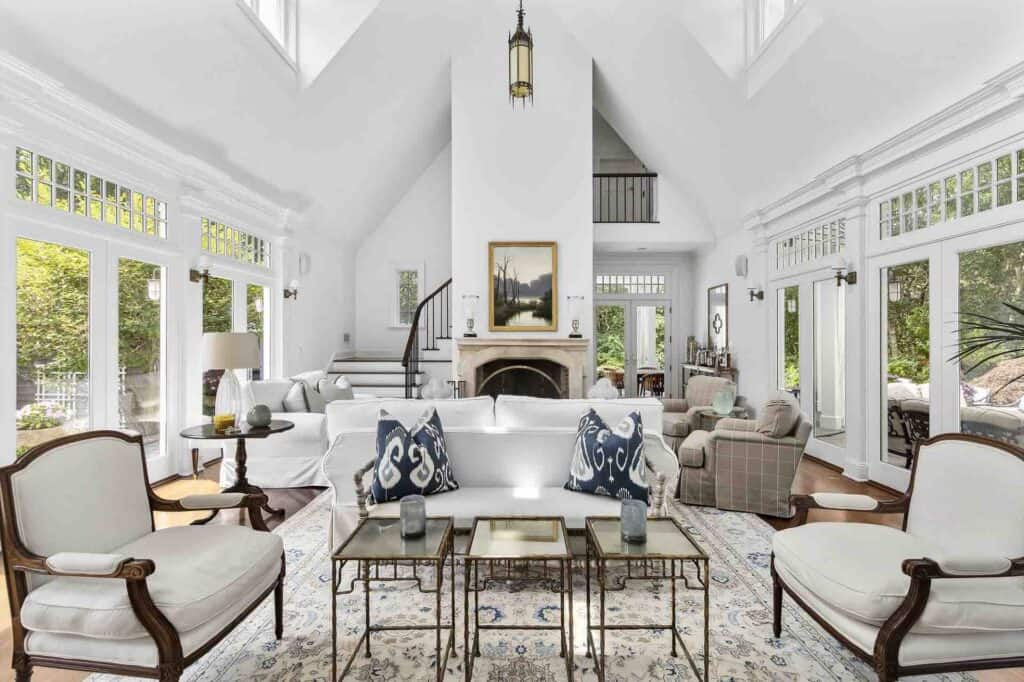
Naturally, this is not your average Hamptons spec build with gray oak floors and a bowl of decorative lemons. DeCourcy enlisted celebrated interior designer Heidi Caillier, whose layered, richly textured aesthetic helped transform the house into what can only be described as “English countryside meets extremely successful advertising executive.”
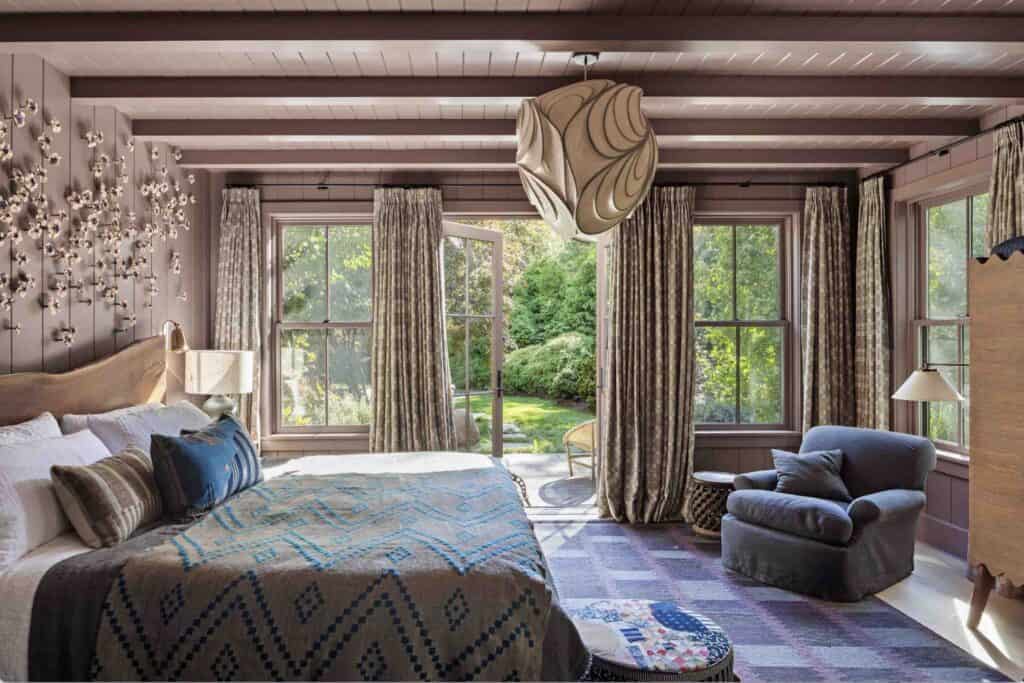
Presented by Jenny Landey and Anthony Rosina at Sotheby’s
The kitchen alone deserves its own publicist. There’s a deVOL kitchen with Sub-Zero and Wolf appliances, hand-painted tile work by BDDW, and a butler’s pantry painted in carmine red because apparently even pantry storage now requires a point of view.
Elsewhere, there are hand-painted walls, marble fireplaces, French doors, built-in libraries, and enough bespoke millwork to keep several craftspeople emotionally fulfilled for years. The landscaping, designed by Charlie Marder, includes towering Lebanese cedars, Asian pines, ginkgos, wisteria, and fruit trees arranged with the sort of precision usually reserved for European palace grounds.
There’s also a hidden path leading to a sauna outbuilding because no modern Hamptons compound is complete without at least one vaguely Scandinavian wellness structure tucked behind ornamental grasses.
The lower level includes a gym, media room, wet bar, kitchenette, additional laundry room, and guest accommodations — essentially an entire second residence concealed underground for visitors who are either very close friends or children returning from college with suspiciously vague career plans.
The transaction also reflects a broader truth about the Hamptons economy: people may complain endlessly about crowds, prices, and traffic, but they continue spending money here with extraordinary enthusiasm. Investors notice these things.
Curves, Please
Over in Bridgehampton, another notable property is testing the market with a different pitch altogether: old-school architectural gravitas.
The estate at 724 Millstone Road, asking $6 million, sits on five acres in Bridgehampton horse country and was designed by Barnes Coy Architects, a firm long associated with elegant, highly contextual Hamptons design before every new build started resembling a boutique hotel in Aspen. Casey Edelstein at Kenilworth Equities Ltd has the listing.
At 5,700 square feet, the house is substantial without veering into oligarch excess. The estate’s defining feature as its recurring curved architectural forms — rounded walls, semi-circular spaces, curved terraces, and a dramatic half-moon-shaped pool that mirrors the home’s geometry.
In other words: finally, a Hamptons house brave enough to reject the tyranny of the rectangle.
Presented by Casey Edelstein at Kenilworth Equities Ltd.
The interiors lean heavily into craftsmanship: limestone floors, oak detailing, mahogany doors, soaring ceilings, and expansive windows framing pastoral views. The great room, with its 24-foot ceilings and Jerusalem stone fireplace, anchors the home with the sort of quiet drama increasingly absent from newer construction, where square footage often substitutes for actual design ambition.
The setting itself may be the biggest luxury. Bridgehampton horse country still retains a calmer, more rural character than the village centers. There are open skies, long driveways, mature trees, and enough privacy to briefly forget your neighbors are probably discussing crypto losses over dinner nearby.
London Calling
When Adam D. Modlin founded his boutique luxury real estate firm in 1999, he built it around a single conviction: that the highest level of service requires restraint, not scale. For 27 years, that philosophy held. Now it has found its global complement. Modlin Group has entered an exclusive partnership with Knight Frank, one of the world’s most respected names in luxury property. “For 27 years, Modlin Group has remained intentionally boutique,” Modlin says. “We are focused on serving our private clients in New York and the Hamptons with care, discretion, and thoughtful attention. We are thrilled to have found that with Knight Frank — a benchmark of integrity and the highest standards of excellence.” For Christopher Covert, managing director and associate broker at Modlin Group Hamptons, the implications are immediate. “Our clients now have a stronger global presence across more than 600 markets worldwide.”
The move pairs Knight Frank’s enormous international network with Modlin Group’s highly discreet boutique operation, which has quietly brokered some of the region’s largest trophy sales, including East Hampton deals exceeding $100 million.
Today’s luxury buyer may own homes in the Hamptons, Palm Beach, Aspen, Manhattan, and the South of France while technically residing nowhere long enough to unpack properly. For firms chasing that clientele, local expertise alone is no longer enough.

Modlin Group Hamptons
The Hamptons market itself continues occupying a fascinating place in the broader economy. Even amid higher interest rates, geopolitical uncertainty, and market volatility, the ultra-luxury segment remains remarkably resilient. Prime Hamptons real estate has evolved beyond mere vacation housing into a global wealth asset — part lifestyle purchase, part status marker, part inflation hedge.
Which explains why retail centers are selling for record numbers, creative executives are listing design-forward compounds for eight figures, and international brokerage firms are racing to expand their East End footprints.
The Hamptons, in other words, remain exactly what they’ve long been: a tiny coastal ecosystem where staggering wealth, aspirational branding, and highly competitive hydrangea maintenance somehow coexist in perfect harmony.